Blog / Maintenance

Preparing Your Diesel Truck for Wyoming Winter: The Complete Cold-Weather Guide

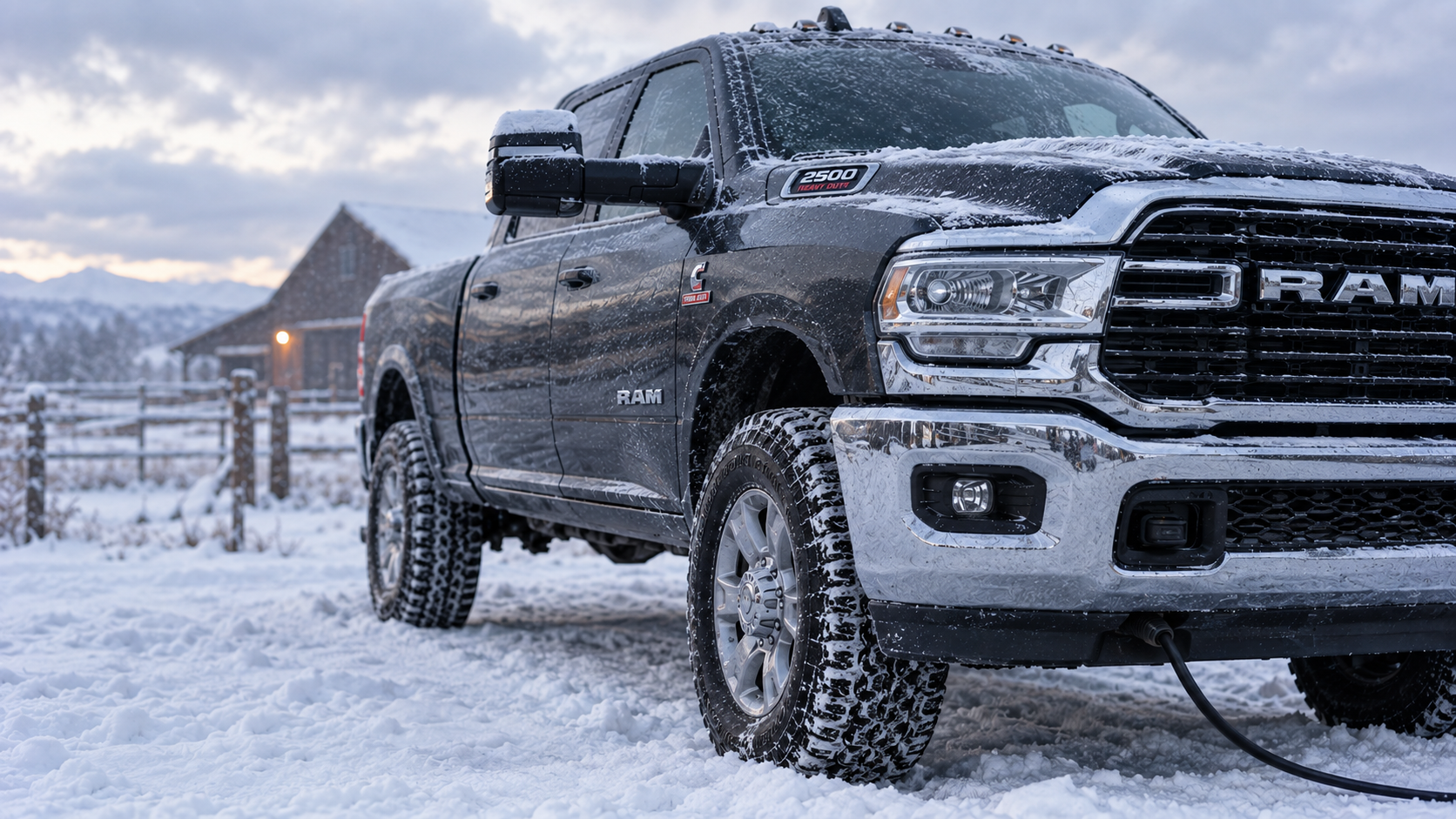
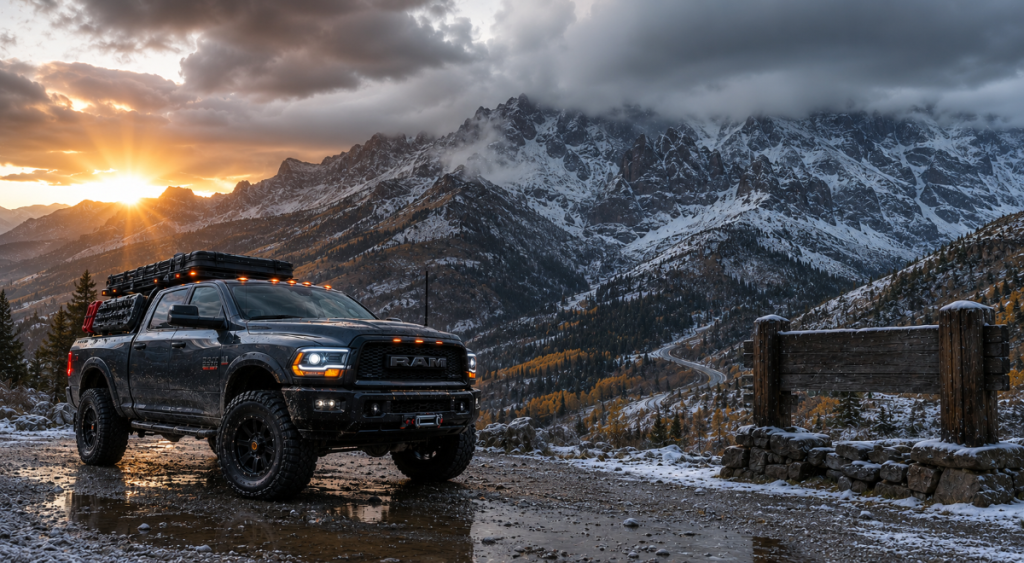
RAM Truck block heater plugged in
Winter Diesel Essentials: Cold-Weather Key Takeaways
Block Heater Timing (2-3 Hours)

Plug in when temperatures drop below 20°F (mandatory below 0°F). Use an outdoor heavy-duty appliance timer set for 2 to 3 hours prior to startup to achieve peak core temperature without wasting electricity.

Anti-Gel Before You Pump

Paraffin wax begins falling out of diesel fuel below 15°F. Always add anti-gel additive directly into the tank at the fuel pump before dispensing fuel so it blends properly before fuel crystallizes.

Dual Batteries & 5W-40 Synthetic

Diesel engines require massive compression (16:1+) to ignite. Test dual batteries for 850+ CCA each, and switch to full synthetic 5W-40 oil for immediate cold-flow lubrication to turbochargers and bearings.

Winter in northern Wyoming presents some of the most unforgiving driving environments in North America. Across Powell, Park County, and the greater Bighorn Basin, winter temperatures routinely plunge to -20°F or lower, accompanied by fierce winds whipping across Highway 14A. While heavy-duty diesel trucks including the Ford Super Duty 6.7L Power Stroke and Ram 2500/3500 6.7L Cummins Turbo Diesel are built for heavy towing and rugged durability, cold weather introduces severe physical challenges for diesel combustion, fuel delivery, and electrical systems.

Unlike gasoline engines that ignite fuel with a spark plug, diesel engines rely on high-pressure compression ignition. When ambient air is below zero, cold engine iron rapidly pulls heat out of the combustion chamber, preventing atomized fuel from igniting. Preparing your diesel pickup before winter's first sub-zero blast protects your high-pressure fuel pump, starter motor, and battery bank while ensuring your truck fires up reliably on the coldest Wyoming mornings.

1. The Engine Block Heater: Master Your Plug-In Strategy

The engine block heater is your diesel truck’s most critical cold-weather ally. Submerged directly into the engine cylinder block coolant jacket, the heating element warms the engine coolant, which circulates through natural thermal convection to warm the cylinder walls, combustion chambers, and upper oil passages.

When to Plug In: Temperature Rules

Modern common-rail diesels with rapid-fire glow plugs or grid heaters will often start down to 15°F without being plugged in. However, once temperatures dip below 20°F, plugging in is strongly recommended to reduce cylinder wear. When overnight lows fall below 0°F, plugging in is mandatory to prevent extreme battery discharge and extended cranking.

Timer Setup vs. All-Night Electricity Draw

Most heavy-duty diesel block heaters draw between 1,000 and 1,500 Watts (roughly 8.5 to 12.5 Amps). Leaving your block heater plugged in all night (10 to 12 hours) consumes substantial electricity without added benefit. Thermodynamic tests demonstrate that an engine block reaches maximum heat soak within 2 to 3 hours. Use an outdoor-rated heavy-duty timer set to turn on 3 hours before your morning departure.

Extension Cord Gauge & Fire Safety

Never connect your 1,500W block heater to a light-duty household 16-gauge extension cord. Undersized cords experience heavy voltage drop, become dangerously hot, and can trigger fires or trip GFCI breakers. Always use a commercial-grade, outdoor-rated 12-gauge (12/3 SJTW) or 10-gauge extension cord rated for a minimum of 15 Amps.

Pro Tip: Inspect Your Bumper Plug Before Freezing Weather

The block heater electrical plug is positioned behind the front bumper or tow hook where it absorbs road spray, mud, and liquid magnesium chloride de-icer from Wyoming highways. Before winter arrives, inspect the male prongs for green corrosion, cracked insulation, or melting. Clean the contacts with electrical contact cleaner, apply a light coat of dielectric grease, and ensure the protective rubber cap remains snapped in place when driving.

2. Diesel Fuel Gelling, Winter Blends & Anti-Gel Additives

Fuel gelling is the most common reason diesel trucks end up on the back of a flatbed during the first deep freeze. Standard Number 2 (#2) diesel fuel contains natural paraffin wax molecules that provide high energy density and lubricity. However, as ambient temperatures drop below 15°F (the Cloud Point), this paraffin wax crystallizes out of liquid solution into a cloudy haze.

At roughly 0°F (the Cold Filter Plugging Point or CFPP), these wax crystals agglomerate into a thick, petroleum-jelly-like gel that instantly clogs the microscopic 2-to-4-micron pores of your fuel filters. Starved of fuel, the high-pressure fuel pump cavitates, and the engine immediately dies.

Preventative Anti-Gel vs. Emergency De-Gellers

  • The Golden Rule of Anti-Gel: Preventative anti-gel additives (such as Motorcraft PM-23-A, Stanadyne, or Howes) work by coating wax molecules and preventing crystal growth. Anti-gel must be poured directly into the tank at the fuel pump before dispensing warm fuel from the underground tank to ensure thorough mixing. Anti-gel cannot dissolve wax that has already crystallized in a frozen filter.
  • Emergency De-Gellers (Emergency 911): Products formulated with high-alcohol compounds should only be used as a last resort on the side of the road. While they melt gelled wax to restore fuel flow, they strip lubricity from high-pressure fuel pumps and dry out internal O-ring seals.
  • Winter-Blend Diesel: Northern Wyoming fuel stations blend kerosene (#1 Diesel) with #2 Diesel during mid-winter. However, early season autumn storms often hit before stations complete their winter transition. Always carry a bottle of quality preventative anti-gel in your truck toolbox.

3. Fuel-Water Separators: Drain Condensation Before It Freezes

In Wyoming’s dry climate, rapid daily temperature swings, such as sunny 45°F afternoons followed by sub-zero nights, cause condensation to accumulate on the inner metal and polymer walls of fuel tanks. This condensation settles to the bottom of your fuel-water separator bowl.

If not drained regularly, trapped water freezes solid at 32°F. Expanding ice can shatter the water separator housing or break off ice crystals that enter the high-pressure common-rail fuel pump. Because modern common-rail injection systems operate between 25,000 and 36,000 psi, even microscopic water droplets cause hydraulic erosion, rust, and catastrophic injector seizure.

  • Drain Monthly in Fall, Weekly in Deep Winter: Turn the primary fuel-water separator drain petcock under the frame rail until water droplets clear and clean diesel fuel emerges into a clear inspection container.
  • Replace Fuel Filters Before Winter: Install new primary and secondary OEM fuel filters every autumn. A partially clogged filter has reduced surface area and gels significantly faster than a clean filter.

4. Dual Batteries & Cold-Cranking Amps (CCA)

Heavy-duty diesel engines utilize two high-capacity 12-volt batteries wired in parallel. Rotating an 8-cylinder or inline-6 diesel against a 16:1 to 18:1 compression ratio requires immense starter torque—especially when motor oil has thickened in sub-zero cold.

Battery electrochemistry slows dramatically in cold weather. At 0°F, a standard lead-acid battery retains only 60% to 65% of its rated cranking amperage, while the frozen engine simultaneously demands nearly double the cranking effort to turn over.

Dual Battery Load Testing

Have both batteries tested under an active carbon-pile load test. A battery showing 12.6 volts with a voltmeter can still drop to 8 volts under high cranking amperage. Both batteries must deliver 850+ Cold Cranking Amps (CCA).

The Matched Pair Rule

Because diesel batteries operate in parallel, replacing only one aging battery causes the older, degraded battery to draw parasitic power from the new battery. When replacement is needed, always replace both batteries simultaneously with identical AGM or heavy-duty lead-acid units.

Terminal Cleaning & Protection

Corrosion on battery terminals adds electrical resistance, robbing glow plugs and starters of peak voltage. Remove cables, scrub terminals with a wire brush, and coat connections with anti-corrosion sealant.

5. Motor Oil: Switch to Full Synthetic 5W-40

Conventional 15W-40 diesel motor oil is excellent for summer towing across the Big Horn Mountains, but below 20°F, conventional base oils thicken into a slow-moving sludge. During a sub-zero cold start, thick 15W-40 can take 15 to 30 seconds to reach the upper valvetrain, hydraulic lifters, and turbocharger journal bearings, causing severe metal-on-metal friction.

Switching to an API CK-4 certified full synthetic 5W-40 diesel motor oil ( Full Synthetic 5W-40 or Valvoline Premium Blue Extreme) delivers critical cold-weather protection. Full synthetic 5W-40 maintains fluid pourability down to -40°F, establishing immediate oil pressure within 2 to 3 seconds of ignition to protect expensive turbocharger bearings.

6. Winter Front Grille Covers & Thermal Efficiency

Modern diesel engines operate with high thermal efficiency, producing relatively little waste heat when cruising without a heavy load or idling. In sub-zero Wyoming winds, cold air flowing through the massive front radiator can overcool the engine, preventing coolant from reaching its optimal 190°F to 210°F operating window.

Overcooling leads to wet stacking, a condition where incomplete combustion allows unburnt diesel fuel to wash past piston rings into the oil pan, contaminating your motor oil. Furthermore, low exhaust gas temperatures prevent the Diesel Particulate Filter (DPF) from completing active regenerations, triggering exhaust soot clogs.

  • Install OEM Vinyl Winter Fronts: Fit the heavy-duty winter grille cover that came with your Ford or Ram truck when sustained temperatures remain below 32°F.
  • Adjust Flaps on Highway Drives: Open the center flap vents when hauling heavy trailers up mountain grades or when ambient temperatures rise above 40°F to prevent engine overheating.

7. Diesel Exhaust Fluid (DEF) Winter Considerations

Diesel Exhaust Fluid (DEF) is a standardized solution composed of 32.5% high-purity urea and 67.5% deionized water. Because of its water content, DEF freezes solid at 12°F (-11°C).

Diesel trucks are engineered with built-in electric heating elements inside the DEF tank and heated fluid delivery lines. The engine control module (ECM) is programmed to allow normal vehicle operation while the heating element thaws fluid in the tank. However, winter DEF care requires two crucial habits:

  • Never Overfill the DEF Tank in Winter: Like pure water, DEF expands by approximately 7% upon freezing. Overfilling the neck to the brim can crack the plastic DEF reservoir or damage the internal heater sensor head. Stop pumping at the first automatic click.
  • Store Spare DEF Jugs Indoors: Keeping a spare jug of DEF in an unheated truck bed causes it to freeze solid, rendering it unusable when your dashboard warning indicator illuminates.
Service Department Expert Advice: Northern Wyoming Winter Preparedness

“Nine times out of ten, when a diesel truck is towed into our Powell service department during our first severe cold snap, it isn’t a mechanical engine failure. It’s gelled fuel from a truck that was filled with summer blend before a storm, or a pair of three-year-old batteries that read 12.5 volts on a multimeter but completely collapsed under an actual 500-amp starter load test. Plugging in your block heater on an appliance timer for three hours in the morning, keeping fresh fuel filters in place, and running synthetic 5W-40 oil prevents 95% of all winter no-starts.”

Winter Diesel Diagnostic & Maintenance Checklist

Diesel System Cold-Weather Risk Preventative Action Recommended Frequency
Engine Block Heater Hard starting, starter wear, cold-seizure Inspect bumper plug; connect to 12-gauge cord with 3-hr timer Every night below 20°F
Fuel System & Filters Paraffin wax gelling at 0°F; fuel starvation Add preventative anti-gel before fueling; replace fuel filters Every fill-up below 20°F; filters every fall
Fuel-Water Separator Frozen water ice crystals; CP4 pump failure Drain water separator into glass jar until clear diesel flows Weekly in freezing temperatures
Dual 12V Batteries Voltage drop, slow cranking, grid heater failure Carbon-pile load test; clean terminals; replace in matched pairs Pre-winter inspection in October/November
Engine Motor Oil Oil starvation at cold start; turbo bearing wear Upgrade to API CK-4 full synthetic 5W-40 diesel oil Every 5,000 to 7,500 miles (before winter)
Winter Front Grille Overcooling, wet stacking, failed DPF regenerations Install OEM front vinyl grille cover; adjust center flaps Sustained temperatures below 32°F
Diesel Exhaust Fluid Frozen fluid expansion cracking tank housing Do not overfill DEF tank; allow 10% headspace for expansion Winter fill-ups

*Disclaimer: Fremont Care comes with eligible vehicle purchases, providing 2 oil changes and 2 tire rotations within the initial 12 months of ownership on qualifying/eligible vehicle purchases. Model-year and diesel engine volume exclusions apply. See dealer for full program terms and vehicle eligibility.

Schedule Your Winter Diesel Inspection at Fremont Motor Powell

Whether you rely on your diesel truck for agricultural work across the Bighorn Basin, commercial hauling on Highway 14A, or towing mountain trailers into Cody and Yellowstone country, reliable winter performance is non-negotiable.

Our factory-certified diesel technicians at Fremont Motor Powell specialize in Ford Power Stroke and Ram Cummins Turbo Diesel platforms. From dual-battery load testing and fuel-water separator maintenance to synthetic oil changes and block heater diagnostics, our team ensures your truck is engineered to master northern Wyoming’s toughest winter conditions.

Frequently Asked Questions

How long should I leave my diesel block heater plugged in?

Most OEM block heaters reach maximum engine temperature within 2 to 3 hours. Leaving your block heater plugged in all night wastes electricity without warming the engine any further. Use a heavy-duty 15-amp outdoor appliance timer set to turn on 2 to 3 hours before you plan to start your truck.

Can I add anti-gel to my diesel tank after the fuel has already gelled?

No. Standard preventative anti-gel additives must be added before fuel gels to modify wax crystal formation. If your fuel has already gelled and clogged your filters, you must either move the truck into a heated garage, replace the fuel filters, or use a specialized emergency de-gelling additive (such as Diesel 911) followed by filter replacement.

Why does my diesel truck need two 12-volt batteries?

Diesel engines operate with extreme compression ratios (16:1 to 18:1) and require immense starter power to turn over heavy internal components in cold weather. Additionally, pre-heating systems like glow plugs and Cummins intake grid heaters draw 100+ Amps before the starter even engages. Two batteries wired in parallel provide the necessary 1,700+ combined Cold Cranking Amps (CCA).

Will frozen Diesel Exhaust Fluid (DEF) damage my truck?

Modern diesel trucks feature built-in electric heating elements inside the DEF reservoir and lines, allowing the vehicle to run normally while the fluid thaws. However, DEF expands by roughly 7% when freezing. To prevent cracking the tank or internal sensor assembly, avoid topping off the DEF tank to the filler neck in winter.

Posted in:

Related Posts

Ford F-150 driving in winter

All-Terrain vs. Winter Tires for Park County Roads: Which Do You Need?

Quick Decision Guide: All-Terrain vs. Winter Tires in Park County Choose 3PMSF All-Terrain Tires If: You drive a 4x4 pickup or body-on-frame SUV (Ford F-150, Super Duty, Bronco, Ram 1500/2500, or Jeep Wrangler), split driving between paved highways and gravel Park County ranch roads, tow trailers, and want one year-round tire set stamped with the Three-Peak Mountain Snowflake (3PMSF) rating. Choose Seasonal Winter Tires If: You commute daily on US-14A or WY-120 between Powell, Cody, and Lovell in sub-zero temperatures, drive an AWD crossover or family SUV, or regularly cross black ice along the Shoshone River corridor and steep mountain passes where maximum ice braking grip is critical. The 45°F Rubber Rule Standard highway all-season and non-3PMSF tires stiffen below 45°F. True winter tires use high-silica hydrophilic compounds and thousands of micro-sipes that stay pliable at -20°F, shortening stopping distances on glare ice by up to 30 feet compared to all-season rubber. Drivers in Powell and across the Big Horn Basin face a unique combination of winter road surfaces. In a single week, your truck or SUV may travel across dry wind-swept pavement on US Highway 14A, frozen morning black ice near the Shoshone River bridges, sharp crushed gravel on rural county roads around Heart Mountain and Garland, and deep snowdrifts climbing toward Cody or Burgess Junction. Because Park County winters combine sub-zero cold snaps with stretches of dry asphalt and rough gravel, the most common question our service and parts team at Fremont Motor Powell (1000 US Highway 14A) hears every fall is: Should I run Three-Peak Mountain Snowflake (3PMSF) all-terrain tires year-round, or swap to a seasonal set of winter snow tires? Below is how both tire categories compare in real Northern Wyoming conditions. 1. Rubber Chemistry at Sub-Zero Temperatures: The 45°F Threshold The primary difference between standard highway tires, severe-snow-rated all-terrain tires, and seasonal winter tires is the glass transition temperature of their rubber tread compound: Standard M+S All-Season & Traditional All-Terrain Tires: Formulated with harder carbon-black polymers to maximize tread life in 80°F summer heat, standard compounds begin losing elasticity below 45°F (7°C). When Powell overnight lows drop to 0°F or -20°F, non-winter tread blocks harden like hockey pucks and slide across micro-imperfections in frozen asphalt. 3PMSF All-Terrain Tires (All-Weather Hybrid Silica): Modern severe-snow-rated all-terrain tires—such as the Falken Wildpeak A/T4W, BFGoodrich All-Terrain T/A KO3, Goodyear Wrangler DuraTrac RT, and Toyo Open Country A/T III—blend higher silica ratios with reinforced natural rubber. They stay significantly more flexible below freezing than older mud-and-snow tires while resisting chunking on sharp Big Horn Basin rock and gravel. Studless & Studded Winter Snow Tires: Tires like the Bridgestone Blizzak DM-V2, Michelin X-Ice Snow, and Nokian Hakkapeliitta LT3 use ultra-soft, high-silica hydrophilic compounds engineered exclusively for temperatures below 45°F. Even at -25°F, the tread blocks remain soft enough to conform to microscopic ice crystals, though running them through a hot 85°F Wyoming summer will rapidly wear down the soft rubber. Winter snow tires pack thousands of high-density micro-sipes into a soft silica compound for glare ice, while 3PMSF all-terrain tires pair wider void channels and stone ejectors with reinforced sidewalls for gravel and deep snow. 2. What the 3PMSF Symbol Really Means (and What It Does Not Test) When shopping for tires in Powell, you will see two common sidewall markings: M+S (Mud and Snow) and the Three-Peak Mountain Snowflake (3PMSF) symbol. Understanding how each rating is earned prevents dangerous surprises on icy curves: Geometry Only M+S (Mud & Snow) Rating The M+S designation is based strictly on tread geometry—requiring at least 25% open void area across the tread pattern. An M+S tire undergoes zero actual snow or ice traction testing and can use a hard summer-biased rubber compound that stiffens in freezing weather. ASTM F1805 Snow Test 3PMSF (Severe Snow Service) Rating To earn the Three-Peak Mountain Snowflake symbol, a tire must pass the standardized ASTM F1805 test, proving at least a 10% improvement in straight-line acceleration traction on medium-packed snow compared to a standard reference tire. The Critical Ice Distinction: The ASTM F1805 3PMSF test measures forward acceleration in packed snow —it does not measure braking distance or cornering grip on polished glare ice. While a 3PMSF all-terrain tire outperforms standard all-season rubber in unplowed snowdrifts and slush, a true winter tire still delivers superior stopping power on sheer black ice at intersections and highway bridges. 3. Side-by-Side Comparison: 3PMSF All-Terrain vs. Seasonal Winter Tires Use this engineering comparison to evaluate how 3PMSF all-terrain tires, studless winter tires, studded snow tires, and standard all-season tires perform across Park County driving environments: Performance Factor 3PMSF All-Terrain Tires Studless Winter / Ice Tires Studded Winter Tires Standard M+S All-Season Sub-Zero Rubber Pliability (< 0°F) Good (moderate silica blend balances cold grip and tread life) Superior (soft hydrophilic micro-pore compound stays flexible at -25°F) Very Good (cold-weather compound paired with metal stud pins) Poor (hardens below 45°F, reducing road contact) Unplowed Deep Snow & Ruts Superior (deep 12/32" to 16/32" lugs & biting shoulder blocks) Very Good (directional V-grooves evacuate slush and snow) Very Good (aggressive winter lug spacing) Fair to Poor (shallow grooves pack full of snow) Glare Ice & Black Ice Braking (US-14A) Moderate (fewer sipes per tread block than studless ice tires) Superior (thousands of micro-sipes wick surface water film off ice) Maximum on Sheet Ice (metal studs mechanically claw into frozen ice) Poor (longest stopping distances on polished ice) Gravel Road & Rock Puncture Resistance Superior (heavy 2-ply/3-ply casing, stone ejectors & tough tread) Moderate (soft tread can chip on sharp loose gravel) Good on LT casings; studs can wear on dry gravel/asphalt Fair (light passenger construction) Heavy Towing & Load Range E Stability Superior (widely available in 10-ply rated LT Load Range E) Moderate (softer micro-siped blocks have more lateral squirm under heavy tongue weight) Very Good in LT Commercial sizes (e.g., Nokian LT3 / Winterforce LT) Good on dry highway; poor winter traction under load Seasonal Convenience & Treadwear Run year-round (typically 50,000–65,000-mile treadwear ratings) Seasonal swap required (remove when temps stay above 45°F in spring) Seasonal swap required; noticeable road noise on bare pavement Run year-round in mild climates; inadequate for severe Wyoming winters 4. Matching the Right Tire to Your Vehicle & Park County Driving Routine The right choice depends on what you drive, whether you haul heavy trailers, and where you log your winter miles around Powell, Cody, Lovell, and Meeteetse: Profile 1 • Heavy-Duty Ranch & Tow Trucks Ford Super Duty (F-250/F-350) & Ram 2500/3500 HD Heavy-duty diesel and gas pickups carrying high pin weights or pulling livestock and flatbed trailers require LT-metric Load Range E (10-ply rated, 80 PSI max) tires with stiff sidewalls. Our Recommendation: An LT-rated 3PMSF All-Terrain tire is the top choice for most Park County ranch and work trucks because its reinforced tread blocks resist tearing on frozen gravel and prevent trailer sway on dry highway stretches. If you regularly tow over steep icy passes like US-14A or Chief Joseph Scenic Byway (Dead Indian Pass), consider a commercial LT Load Range E studded or studless winter tire for winter months. Profile 2 • Half-Ton 4x4s & Off-Road SUVs Ford F-150, Bronco, Ram 1500 & Jeep Wrangler / Gladiator Half-ton 4x4 pickups and trail-rated SUVs frequently transition from paved Powell streets to muddy two-tracks, hunting trails, and snowy county lanes. Our Recommendation: If you want a single year-round setup, select a 3PMSF All-Terrain tire with full-depth 3D locking sipes. If your half-ton truck or SUV is primarily a family highway commuter between Powell, Cody, and Billings and rarely leaves paved roads, a seasonal set of studless winter tires will give you noticeably shorter stopping distances on black ice. Profile 3 • AWD Crossovers & Family SUVs Ford Explorer, Bronco Sport, Escape, Jeep Grand Cherokee & Compass Unibody crossovers and three-row family SUVs prioritize predictable steering response, quiet highway manners on US-14A, and emergency stopping power on icy school and work commutes. Our Recommendation: A matched set of four studless ice and snow tires (or mild crossover-specific 3PMSF all-weather tires like the Michelin CrossClimate2 or Falken Wildpeak A/T Trail) delivers the best cold-weather braking and electronic stability control response without sacrificing ride comfort or fuel economy. Profile 4 • Pre-Owned Trucks, SUVs & Commuters Inspecting Tires on Used 4x4 & AWD Vehicles Shopping for a pre-owned truck or SUV in Park County? Every vehicle in our CARFAX® 1-Owner used inventory and our used Chevrolet 4x4 lineup is inspected for remaining tire tread depth, even wear patterns, and proper load index ratings before reaching our Powell lot. Our Recommendation: Our parts and service department can outfit any new or pre-owned purchase with 3PMSF all-terrain or seasonal winter tires prior to delivery. Our factory-trained technicians at 1000 US Highway 14A in Powell measure tread depth across all four tires, verify load ratings, and perform computer-balanced winter mountings and four-wheel alignments. 5. Why 4WD and AWD Do Not Replace Cold-Weather Tire Grip One of the most common winter hazards in Wyoming is overconfidence in four-wheel drive. Whether your vehicle uses a part-time 4x4 transfer case, Ford Intelligent 4WD, Jeep Selec-Terrain®, or Ram BorgWarner active 4WD, drivetrain hardware only helps distribute engine torque to get your vehicle moving. Braking Is 100% Tire-Limited: Every vehicle on the road—whether 2WD, AWD, or 4x4—uses four-wheel brakes. Once you press the brake pedal on an icy intersection in Powell, your transfer case does not slow the vehicle down; stopping distance is governed entirely by the friction between your four tire contact patches and the ice. Cornering & Lateral Stability: When crosswinds push against your truck or SUV on US-14A between Powell and Ralston, lateral grip from flexible winter sipes keeps the front tires tracking through curves instead of plowing straight ahead (understeer). Always Install Winter or 3PMSF Tires in Matched Sets of Four: Never install snow tires on only the front or rear axle. Mixing tire compounds or tread depths on a 4x4 or AWD vehicle creates front-to-rear traction imbalances that can cause sudden spinouts during braking and place severe mechanical binding stress on AWD couplings and transfer cases. 6. Winter Tire Maintenance Checklist for Big Horn Basin Drivers Even the highest-rated 3PMSF all-terrain or winter tire loses winter traction if tire pressure, tread depth, or suspension alignment falls out of specification: Compensate for the 1–2 PSI Per 10°F Cold Pressure Drop: Tire air pressure drops by roughly 1 to 2 PSI for every 10°F decrease in ambient temperature. A truck tire set to 40 PSI on a 60°F October afternoon in Powell will drop to roughly 26 to 30 PSI on a -10°F January morning. Underinflated tires fold their tread sipes closed, reducing ice grip and increasing sidewall flexing. Check cold tire pressures monthly against your driver's door-jamb placard. Retire Winter Tires at 5/32" to 6/32" Tread Depth: While 2/32" is the legal minimum tread depth for dry summer roads, snow traction drops sharply once a tire wears below 5/32" to 6/32" because the shallow lugs can no longer pack snow or flex open their sipes. Many winter snow tires include a secondary winter wear bar molded at 6/32". Rotate Every 5,000 Miles & Check Wheel Alignment: Heavy torque on 4x4 trucks and rough frost heaves on county roads accelerate uneven shoulder wear and cupping. Rotating your tires every 5,000 miles—and checking four-wheel alignment when swapping seasonal sets—maximizes tread life and keeps your steering wheel centered. Fremont Care Maintenance Coverage on Eligible Vehicle Purchases* Purchasing a new Ford, Ram, Jeep, Dodge, or Chrysler—or an eligible pre-owned vehicle—at Fremont Motor Powell? Fremont Care comes with eligible vehicle purchases and provides 2 oil changes and 2 tire rotations within your initial 12 months of ownership *, helping you keep your all-terrain or winter tires evenly rotated through every Wyoming season. Shop Tires & Schedule Winter Service at Fremont Motor Powell Whether you want to outfit your Ford F-150, Super Duty, Bronco, Ram 1500/2500, or Jeep Wrangler with 3PMSF all-terrain tires—or mount a seasonal set of studless or studded winter tires on your family SUV—our parts and service team at Fremont Motor Powell is ready to help. Visit us at 1000 US Highway 14A, Powell, WY 82435, call our service department at (307) 271-3044, or book your appointment online. Schedule Tire Service in Powell Shop New Ford & CDJR 4x4s Browse Used Trucks & SUVs Frequently Asked Questions: All-Terrain vs. Winter Tires in Wyoming Are 3PMSF all-terrain tires as good as seasonal winter tires on black ice? No. While 3PMSF (Three-Peak Mountain Snowflake) all-terrain tires pass the ASTM F1805 test for forward acceleration on medium-packed snow and perform well in deep snow and gravel, studless and studded winter tires use a much softer hydrophilic silica compound and higher sipe density that stops significantly shorter on sheer glare ice and black ice. Can I leave 3PMSF all-terrain tires on my truck all year in Powell, WY? Yes. Unlike seasonal winter snow tires—which wear rapidly when summer temperatures climb above 45°F—3PMSF all-terrain tires are engineered for year-round driving across hot summer highways, gravel Park County ranch roads, and winter snow. Are studded snow tires legal in Wyoming? Yes, Wyoming law permits studded winter tires for cold-weather driving, and they qualify under Wyoming Department of Transportation (WYDOT) snow chain and winter traction laws when Chain Law Level 1 is in effect on mountain passes such as US-14A and Chief Joseph Scenic Byway. What tread depth do I need for safe winter driving in Park County? Our Powell service technicians recommend a minimum of 5/32" to 6/32" of remaining tread depth heading into winter. Once a tire wears below 5/32", its grooves and sipes lose the depth needed to evacuate slush and bite into packed snow. Does Fremont Care include tire rotations on eligible vehicle purchases? Yes. Fremont Care comes with eligible vehicle purchases (including new Ford and CDJR vehicles as well as qualifying pre-owned vehicles at Fremont Motor Powell) and provides 2 oil changes and 2 tire rotations within the initial 12 months of ownership. Contact Fremont Motor Powell at (307) 271-3044 for complete program eligibility details. * Fremont Care Disclosure: Fremont Care comes with eligible vehicle purchases (new Ford and CDJR vehicles and qualifying pre-owned vehicles) and provides 2 oil changes and 2 tire rotations within the initial 12 months of ownership. Excludes new vehicles that include an active OEM maintenance package from new. See Fremont Motor Powell at 1000 US Highway 14A, Powell, WY for complete eligibility and coverage terms. Always verify tire size, load index, speed rating, and cold inflation pressure against your vehicle's door-jamb certification label and Owner's Manual.

Mountain Pass Preparedness: Is Your 4x4 Ready for Wyoming’s Sudden Season Shifts?

AI Generated image. Anyone who lives around Powell knows that the weather forecast here is more of a gentle suggestion than a guarantee. You can start your morning with clear blue skies in town, and by the time you hit the top of the Chief Joseph Scenic Byway or head up into the Bighorns, you’re staring down a sudden whiteout or a torrential downpour. Driving in northwest Wyoming demands a lot from your vehicle. If you want to tackle our mountain passes with confidence, you can’t just assume your 4x4 is ready, you have to know it is. Before you pack up for your next weekend trek, make sure your truck or SUV checks these four critical boxes. 1. The Brake Check: Don't Let the Descent Catch You Off Guard Heading up the mountain is the fun part; coming down is where your vehicle earns its keep. Riding your brakes down steep grades generates massive amounts of heat, which can lead to brake fade (a terrifying moment) where your pedal feels spongy and loses stopping power. What to look for: Listen for high-pitched squeals, grinding noises, or a steering wheel that vibrates when you slow down. The Prep: Have a technician check your pad thickness and ensure your brake fluid isn't contaminated. If you're driving a newer Ford Super Duty or RAM 2500, make sure you know how to properly utilize your exhaust brake and tow-haul modes to let the engine do the heavy lifting. 2. The 4WD Reality Check: Test It Before You Need It Don't wait until you're halfway up a muddy switchback or caught in an unseasonal mountain flurry to find out your four-wheel-drive system is throwing an error code. The Reality: Vehicles that sit in 2WD all summer can experience stiff actuators or vacuum leaks in the 4WD engagement system. The Prep: Find a safe, gravel stretch of road and shift through your 4WD ranges (4-High and 4-Low). Listen for smooth engagement. If there’s a delay, a loud clunk, or a flashing dash light, it’s time to bring it into the shop. 3. The Battery: Altitude and Temp Drops are Brutal Wyoming winters get all the credit for killing batteries, but sudden temperature drops at high elevations can easily strand an aging battery. If your battery is more than three or four years old, a cold night at a mountain campsite might leave you clicking your tongue instead of turning over the engine. 🛠️ Local Pro-Tip: Elevation changes don't just change the view; they test your vehicle's electrical connections. Vibrations from rough washboard roads can loosen battery terminals over time. Give them a quick wiggle to ensure they’re tight and free of corrosion. 4. Tires: The Only 4 Points of Contact Your Jeep’s lockers or your RAM’s torque won’t mean a thing if your tires can’t grip the terrain. Wyoming passes require tires that can handle rapid transitions from dry pavement to slick mud, gravel, or slush. The Penny Test: Insert a penny upside down into your tread. If you can see the top of Lincoln’s head, you have less than 2/32" of tread depth—meaning your tires are legally bald and unsafe for mountain driving. Pressure Drops: For every 10-degree drop in ambient temperature, your tires can lose about 1 PSI of pressure. Going up in elevation changes things even further. Always check your spare tire before you leave town! Let Fremont Motor Powell Prep Your Rig You shouldn't have to white-knuckle your way through the mountains. Whether you’re driving a rugged Jeep Gladiator, a Ford Bronco, or a dependable family SUV, our factory-trained technicians know exactly what Wyoming roads demand. Before your next mountain adventure, schedule a Multi-Point Safety Inspection at Fremont Motor Powell. We’ll check your brakes, test your battery, inspect your drivetrain, and make sure you’re ready for whatever the Bighorns throw at you. 👉 Schedule Your Service Appointment Here

Introducing the Grand Cherokee L: Why 3-Row SUVs Are Perfect for Wyoming Families

The daily routine for a family in Powell requires a vehicle that handles both the morning school run and sudden mountain weather changes without skipping a beat. The 2026 Jeep Grand Cherokee L answers this need by stretching the legendary capability of the standard model into a spacious, three-row platform. It provides seating for up to seven passengers, giving larger families the room they need to travel together in a single vehicle rather than taking two. Our team at Fremont Motor Powell frequently meets parents who love the classic Jeep styling but simply outgrew the traditional two-row cabin. When you step into our showroom at 1000 W Coulter Ave, US-14 ALT, Powell, WY 82435, to explore our inventory, you will see how this longer wheelbase adds stability and interior volume without losing the rugged utility the brand is known for. If you want to discuss which configurations are currently sitting on our lot, you can give our sales team a quick call to get the latest details. This family-friendly SUV is designed to keep everyone safe and comfortable, which is why it comes standard with a suite of safety features including Forward Collision Warning, Lane Departure Warning, Crash Imminent Braking, and Dynamic Brake Support. It also earned a five-star overall safety rating from the NHTSA, scoring five stars in every single category except rollover resistance, where it secured four stars. For parents prioritizing security on highway trips, this high safety rating provides peace of mind before you even pull out of the driveway. Table of Contents Power and 4x4 Capability Built for Mountain Roads and Passes Inside the Cabin: Third Row Legroom and Cargo Space for Real Gear Which 2026 Jeep Grand Cherokee L Trim Offers the Best Value for Your Family? Quick Answers for Grand Cherokee L Buyers Drive Home Your Next Family SUV From Fremont Motor Powell Power and 4x4 Capability Built for Mountain Roads and Passes While many three-row crossovers rely on light-duty all-wheel-drive systems, this SUV offers serious mechanical 4x4 systems designed for actual trail and mountain driving. For example, climbing the steep, high-elevation switchbacks of the Beartooth Highway near Red Lodge requires the kind of sustained torque and cooling performance that standard crossovers cannot deliver. Entry-level trims are powered by the proven 3.6-liter V6 engine producing 293 horsepower and 260 lb-ft of torque, which is paired with a smooth-shifting 8-speed automatic transmission. For families who want enhanced mountain-climbing power and passing performance, 2026 introduces the all-new 2.0-liter Hurricane 4 Turbo engine as the standard powertrain on Altitude, Limited, and Summit trims. Delivering 324 horsepower and a muscular 332 lb-ft of torque, this high-output turbocharged engine gives you instant low-end muscle for tackling steep highway passes. When equipped with the available Trailer Tow Package, both engines deliver a class-leading maximum towing capacity of up to 6,200 pounds, perfect for pulling campers, horse trailers, or recreational gear into the mountains. Fuel efficiency remains practical for daily driving thanks to modern engineering. The new 2.0L Hurricane 4 Turbo engine achieves an EPA-estimated 21 mpg city and 26–27 mpg highway, while the V6 configuration offers up to 19 mpg city and 25–26 mpg highway. With a large 23-gallon fuel tank capacity, you can enjoy a best-in-class estimated driving range of up to 529 miles on a single tank without constantly scanning the highway for the next gas station. If you are looking for this level of capability at a lower starting cost, we recommend browsing our selection of used vehicles to find a model that fits your budget. Inside the Cabin: Third Row Legroom and Cargo Space for Real Gear Cargo dimensions and seating flexibility are often the deciding factors for families upgrading to a larger vehicle. The 2026 Jeep Grand Cherokee L offers a choice between a three-person second-row bench seat for seven-passenger seating or individual second-row captain's chairs that reduce capacity to six passengers but create an open center aisle. Third-row passengers enjoy about 30 inches of legroom, which is spacious enough for children and comfortable for adults on shorter trips across town. When families test-drive this SUV at our dealership, they usually try out the second-row tilt-and-slide mechanism first, checking how easily kids can climb into the back without removing a child safety seat. Behind that third row, you will find about 17 cubic feet of cargo space, which is plenty of room for a standard cooler and a couple of duffel bags. If you need to haul larger items, folding the third row opens up about 47 cubic feet, and folding both rear rows flat creates a massive, flat load floor of about 85 cubic feet. To experience this spacious cabin and check out updated interior tech like the standard 12.3-inch Uconnect 5 touchscreen in person, you can schedule a test drive in a new car or, if you prefer, schedule a test drive in a used car to compare different model years. Every eligible vehicle purchase from our team also comes with the added confidence of the Fremont Care program, which includes complimentary tire rotations, oil changes, and roadside assistance to protect your investment. Which 2026 Jeep Grand Cherokee L Trim Offers the Best Value for Your Family? Ranchers and outdoor enthusiasts around Buffalo need a vehicle that can transition from rugged dirt roads to clean highway cruising without losing its composure. Finding the right balance between premium features and a practical price tag comes down to choosing the right trim level. The 2026 Jeep Grand Cherokee L is available across a versatile trim lineup: Laredo, Laredo X, Altitude, Limited, Overland, Summit, and Summit Reserve. For most families, the Limited trim represents the ideal sweet spot for value and utility. It upgrades the cabin with the larger 12.3-inch touchscreen, premium materials, heated front and second-row seats, a heated steering wheel, and standard four-wheel drive essential for navigating snowy winter commutes safely. If you prefer a more rugged, blacked-out aesthetic, the Altitude trim offers a stylish alternative with dark exterior accents, upgraded wheels, and the standard Hurricane 4 Turbo engine. On the higher end, the Overland, Summit, and Summit Reserve trims cater to buyers who want premium luxury alongside maximum capability. These upper tiers offer features like the Quadra-Lift air suspension system, fine leather upholstery, and ventilated seats with massage functions. If you are ready to upgrade your current vehicle, our team can help you get an accurate value for your trade-in online so you can apply that equity directly toward your next SUV. Quick Answers for Grand Cherokee L Buyers Q: Does the third row have lower anchors for child safety seats? The third row features standard top tether anchors on the seatbacks, but lower LATCH anchors are typically reserved for the second-row seats. This setup allows you to secure booster seats or use seatbelt-installation methods for child seats in the very back while utilizing the full LATCH system in the middle row. Q: What is the real-world driving range on a single tank of gas? With its large 23-gallon fuel tank and an EPA-estimated rating of up to 26–27 mpg highway on the 2.0L Hurricane 4 Turbo engine, this SUV can travel up to 529 miles on a single tank under optimal highway conditions. This long range is highly practical for driving across wide-open stretches of highway where fuel stops can be far apart. Q: What are the standard warranty terms included with a new model? Every new model comes backed by a 3 years / 36,000 miles basic warranty and a 5 years / 60,000 miles drivetrain warranty. Additionally, a 5 years / 60,000 miles roadside assistance warranty is included to provide help with flat tires, towing, or lockouts when you are on the road. Q: Is there a plug-in hybrid 4xe version available for the three-row L model? The plug-in hybrid 4xe powertrain remains exclusive to the two-row Grand Cherokee model. The three-row L model is powered strictly by gas powertrains—the standard 3.6L V6 or the high-output 2.0L Hurricane 4 Turbo—ensuring consistent 6,200-lb towing capacity and mechanical 4x4 power for heavy-duty family hauling. Q: How can I speed up the purchasing process before visiting the dealership? You can save significant time at the dealership by browsing our current inventory of new vehicles online to find the exact trim you want. After finding your preferred vehicle, you can submit a secure credit application to get pre-approved for financing before you walk through our doors. Drive Home Your Next Family SUV From Fremont Motor Powell Choosing a vehicle that can handle both the daily routine and rugged outdoor weekend trips is a major decision for any family. The 2026 Jeep Grand Cherokee L delivers the perfect blend of passenger space, towing power, and legendary 4x4 capability to keep your family moving safely. Our team at Fremont Motor Powell is dedicated to helping you find the exact trim and configuration that fits your lifestyle and your budget without any high-pressure sales tactics. We invite you to stop by our showroom to compare trims side-by-side, test out the third-row seating, and experience the smooth ride quality for yourself. For easy navigation to our lot, you can get directions to Fremont Motor Powell online. If you have any questions about current inventory, trade-in values, or financing options, please call our sales team at (307) 206-2827 to speak with a local expert today. Keep Your Vehicle Running Strong Keep your vehicle performing at its best with our service team: order parts schedule service © 2026 Fremont Motor Powell. All rights reserved.